

Ash Dieback Disease (ADB)
Insert image here
Ash dieback (ADB) is a fungal disease of ash trees caused by the hymenoscyphus fraxineus fungus, it affects all species of ash trees (the Fraxinus genus). It is the most significant disease to affect trees in the UK since Dutch elm disease.
In Britain, the disease was first officially recorded in south-east England in 2012, though is now thought to have been present since the early 2000s, it has spread west across the UK and is now affecting all parts of Wales.
The fungus produces spores that become airborne and attach to the leaves of ash trees. The fungus then spreads through the branches where it blocks the water transport systems and causes leaf loss, dieback of the crown, and lesions in the wood and on the bark.
In most cases, this leads to the dieback of the tree crown. Trees become brittle over time causing branches to break away from the main body of the tree. If they are not managed appropriately, trees are at risk of collapsing, presenting an immediate danger to the surrounding area.
There is no known cure or practical way to prevent the spread of the disease and ADB has the potential to kill 90% of ash trees in Ceredigion.
Ash Dieback in Ceredigion
There are thousands of ash trees on public land in Ceredigion and hundreds of thousands more on private land. Ash is one of the most common tree species in the county, and it contributes significantly to the landscape, ecology, and biodiversity.
The effect the disease has on infected trees and the risk these trees may pose to public safety is, unfortunately, going to necessitate the removal of many thousands of ash trees over the coming years.
The current best practice where diseased trees pose a risk to people or property is to remove (or prune if sufficient) infected trees in health classes 3 and 4 (less than 50% leaf cover remaining in summer) to eliminate the risk, as it is recognised that once trees have deteriorated to this extent any recovery is highly unlikely and their structures will be significantly weakened.
For more information on identifying the disease and the ADB-affected tree health classes click here (Link to “Recognising ADB”).
Some ash trees show high levels of resistance to the disease and should not be considered for removal unless other additional issues affect the tree; these trees are very important for the ecological value they retain in the environment, and they will be of great value to repopulate the species in the future.
Even trees that are badly affected by ADB should be retained wherever it is safe to do so, for example where a tree falling would not pose a risk to people or property.
In some instances, it may be appropriate de-limb an affected tree to make it safe, rather than fell it to near ground level.
Ash trees support a wide range of associated biodiversity, such as lichens, bryophytes, and animals that breed, roost, and shelter in the trees, and standing deadwood is a very valuable habitat.
The felling of healthy ash trees, because they may become infected in the future, is not an ethical management strategy and should be avoided.
The Fraxinus Genus of trees, the most common of which is Fraxinus excelsior - European ash (aka Common ash) is a large deciduous tree native to Europe that can grow to a height of 35m.
Image of large healthy ash tree
Its main distinguishing features are:
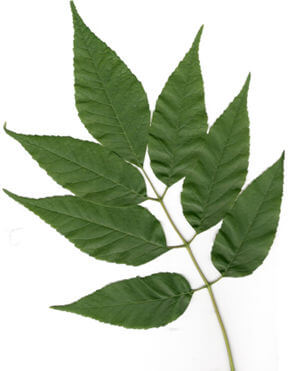
Leaves - Small light green oval serrated-edged leaves which grow in pairs along shoots with a single leaf at the tip.
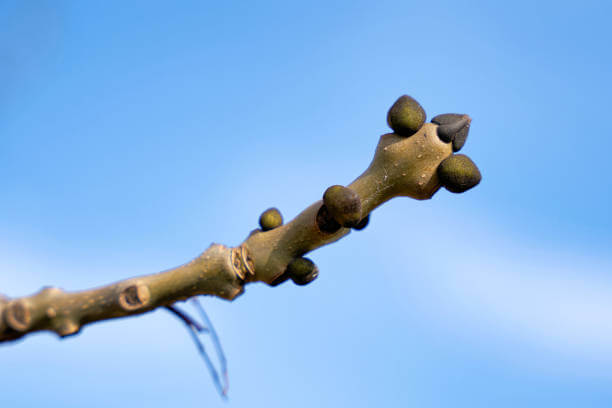
Buds (when not in leaf) - Black pointed buds growing in pairs - one on each side of a grey smooth barked shoot, with three buds close together at the tip, the shoot is also less rounded and flatter where the buds or leaf emerge.
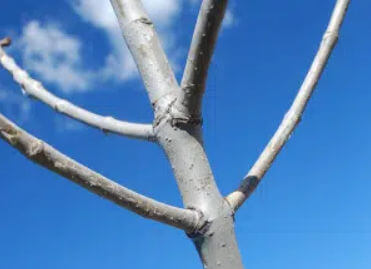
Bark - Young trees have smooth grey bark on the trunk and branches.
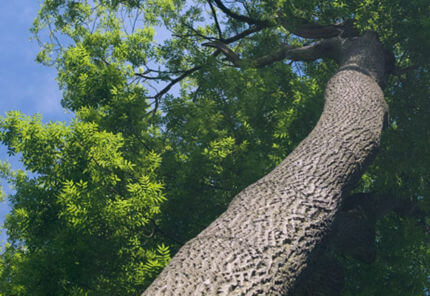
More mature trees have rough longitudinally ridged bark.
Seedpods - Growing in large clusters containing many pods, initially green coloured changing to black as they dry out before dropping from the tree and falling in a spinning action.


Ash dieback affects the leaves of ash trees causing them to blacken, wilt and die from around June onwards.
Image of wilted and healthy leaves next to each other
Young trees may also have diamond-shaped lesions (areas of discoloured bark) on the stem at the base of branches and are features of early infection.


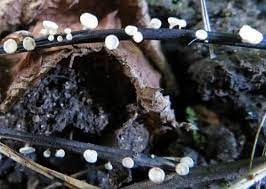
The fruiting bodies of the fungus may be found on dead twigs on the ground in leaf litter under affected trees.
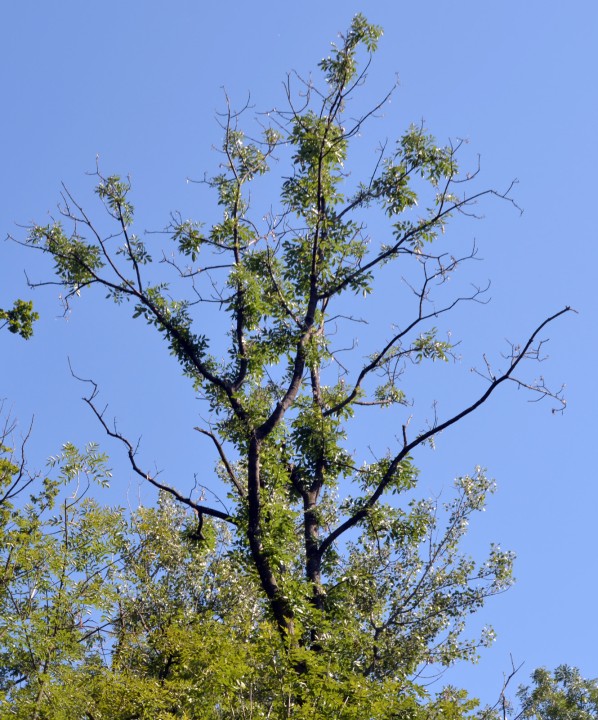
As the name suggests, the disease causes the tree to die back from the edge of its canopy.
In mature trees, the first sign of the disease is bare, dead shoots at the top of the tree and ends of the branches.
As the disease progresses and the number and extent of dead branches increases, the tree responds by growing new shoots & leaves (known as epicormic growth) closer to the main branches and trunk to try to compensate for the loss of foliage, giving the tree a clumpy ‘pom-pom’ look. Eventually, the tree will look increasingly bare and dead.
Ash dieback can also lead to serious discoloration, cracking, and death of the bark at the base of the trunk. Ash trees with these symptoms have a higher risk of sudden death and collapse, so should be a priority for safety works if in a location where they pose a risk to public safety.
Ash dieback tree health classes
Ash trees affected by ash dieback are categorised into one of four health classes, based on the percentage of the healthy crown present. This will help determine which trees will be unsafe. The classes are:
- Class 1 - 100-75% healthy canopy remaining (either unaffected by ash dieback or show early signs of infection)
- Class 2 - 75-50% healthy canopy remaining
- Class 3 - 50-25% healthy canopy remaining
- Class 4 - 25-0%
The last two categories will be heavily affected by the disease and will be a priority for crown reduction or felling, where they would pose a risk when collapsing.
Images of Class 1, 2, 3, & 4 ADB trees
In addition to the structural decay caused by ADB, trees affected may become more susceptible to other pathogens which cause decay, so other health issues in ash trees affected by any class of ADB may have more rapid and serious consequences, therefore any secondary issues should be investigated.
These issues may include:
- Cankers
- Missing Bark
- Insect damage – holes in wood or damage to leaves
- Presence of Fungal fruiting bodies - brackets, mushrooms/toadstools etc, some of which are harmful
- Rot - soft or discoloured wood
Note - Rowan (Sorbus aucuparia) trees commonly known as Mountain Ash is not affected by ash dieback as it is not a member of the ash genus (Fraxinus).
The Council has created and is implementing an Ash Dieback Action Plan (insert link), this includes a prioritised risk-based program of surveying ash trees on council land, and those within falling distance of public spaces, private land adjoining highways, public spaces, and public rights of way. We have surveyed the entire road network and council-owned schools, and are continuing to survey other public spaces.
Where our surveys find trees on council land affected by ADB to class 3 or 4 we will be carrying out tree-cutting work to eliminate any risk.
Where dangerous trees growing on private land have the potential to impact public spaces such as highways, the council will be requiring landowners to act. If those landowners do not act it may become necessary for the council to use statutory powers to act and recharge any costs incurred to landowners.
For every tree Ceredigion County Council removes from its land, we will be planting three replacement trees of native species within the vicinity of the trees removed and urge private landowners to do the same.
Images of diseased tree in public place and tree planting
If you have ash trees on your land that could potentially fall on neighbouring land or property, highways, rights of way, or public places, it is your responsibility to ensure these trees do not pose a safety risk. It is important that the trees are assessed by a suitably qualified, experienced, and insured arboriculturist to establish their health and the level of risk they pose.
Private landowners (including domestic property) have a duty of care under common law to ensure that they do all that is reasonably practicable to prevent injury or damage to others, this includes a duty of care towards visitors to their land, including trespassers, under the Occupiers Liability Acts. The Highways Act also requires landowners to ensure that their trees do not endanger people on roads and footpaths.
The council will be sending notices to landowners requiring affected trees be dealt with. Under Section 154 of The Highways Act 1980 and Section 23 of The Miscellaneous Provisions Act 1976 the council may serve notices to landowners requiring them to act, if action is not taken the council may undertake the necessary work and recharge costs incurred to the landowner.
Businesses have additional obligations under the Health and Safety at Work Act to ensure their workplaces are safe.
For householders, this may require you to keep checking the condition of your ash trees and seek professional advice if/when any become affected.
For larger landowners and businesses, you will need to:
- Identify how many ash trees you have
- Assess their current condition
- Identify where affected trees pose a risk
- Make safe any hazardous trees
- Monitor on an annual basis
The optimum time to survey for ash dieback is between the end of June and September as the dieback will be most apparent while the tree is in full leaf.
Please Note: The unseen structural decay that ash dieback causes to affected trees can render them unpredictable and of far greater risk to cut, prune, or fell than healthy trees. Therefore, trees affected by ash dieback should only be pruned or felled by suitably qualified, experienced, competent, and insured professional arborists or tree surgeons.
The felling of healthy ash trees, because they may become infected in the future, is not an ethical management strategy and should be avoided.
Re-Planting - Where trees have had to be removed, please consider re-planting with other native species, to compensate for the loss in habitat and biodiversity and carbon uptake potential. The following links may be of assistance:
Tree Preservation Orders (TPOs), Felling licenses, and Protected Species
Tree Preservation Orders
Trees may be subject to Tree Preservation Orders. Details of these in relation to ADB are as follows:
- Current TPOs - As described above, it is not recommended to fell healthy trees. Applications for consent to fell both affected and unaffected trees will be judged on their own merits, and the potential for infection of a healthy tree by ash dieback will not be a significant consideration. Felling infected trees under Statutory Plant Health Orders will be an exception
- New TPOs - Until further notice, the potential risk of infection by ash dieback will not be considered a significant justification for not making a TPO, although a confirmed case of ash dieback is likely to be a significant factor weighing against making an order
- Dead and dangerous trees exemptions - Felling required under a Plant Health Order is exempt from the need to obtain TPO approval. If a TPO tree of any species is dead or posing an immediate risk, the works to fell the tree or remove parts that are dangerous is exempt from the need to obtain the Council’s permission for the works. However, the Council must be given five days’ written notice of exempt works
Tree Felling Licenses (Forestry Act 1967)
You may require a felling license to fell trees on your land, even if they are infected with ash dieback. Information on felling licensing can be found on the Natural Resources Wales Check if you need a felling licence page.
Protected Species (Wildlife and Countryside Act 1981)
Nesting Birds: All wild birds’ nests and their eggs are protected. It is an offence to intentionally or recklessly take, damage or destroy the nest of any wild bird whilst that nest is in use or being built.
Bird nesting season is generally from the 1st of March to 31st August, though can extend before and after these dates. It is not illegal to cut trees during this period, but all trees (and surrounding area impacted by the work) must be inspected for the presence of nests/nesting birds before any work commences & work must not go ahead if active nests are present. Further information can be found on the Natural Resources Wales Bird specific licences page.
Bats: All bat species are protected by law, including their breeding sites and resting places. It is against the law to:
- damage or destroy a breeding or resting place
- obstruct access to their resting or sheltering places
- intentionally or recklessly disturb a bat while it’s in a place of shelter, or protection
Before felling any mature trees, these should be checked for potential to support roosting bats. You will require a license from Natural Resources Wales to destroy a resting place or breeding site of any species of bat. For more information see the Natural Resources Wales Bat licensing page.
General information on tree felling and protected species:
- Ceredigion County Council Ash Dieback Action Plan (ADAP)
- Tree Works Application Form
- Tree Works Application Guidance for TPOs and Trees in Conservation Areas
- Tree Preservation Order Information
- Welsh Government Check if you need a felling licence
- Forestry Commission Managing Ash Trees
- Welsh Government Biosecurity Guidance
- The Tree Council's Ash Dieback Action Plan Toolkit
- Woodland Trust Ash
- Welsh Government Chalara Dieback of Ash